Marina Management System: Berth Visibility, Contracts and Vessel Data in One Platform
Marina operators lose revenue in the gaps between a spreadsheet, a paper contract folder and a printed berth layout. Wetelo built an operational platform that closes those gaps — an interactive map where every berth reports its own status, a vessel and owner registry with a document vault, and a contract engine that never lets an agreement expire quietly.
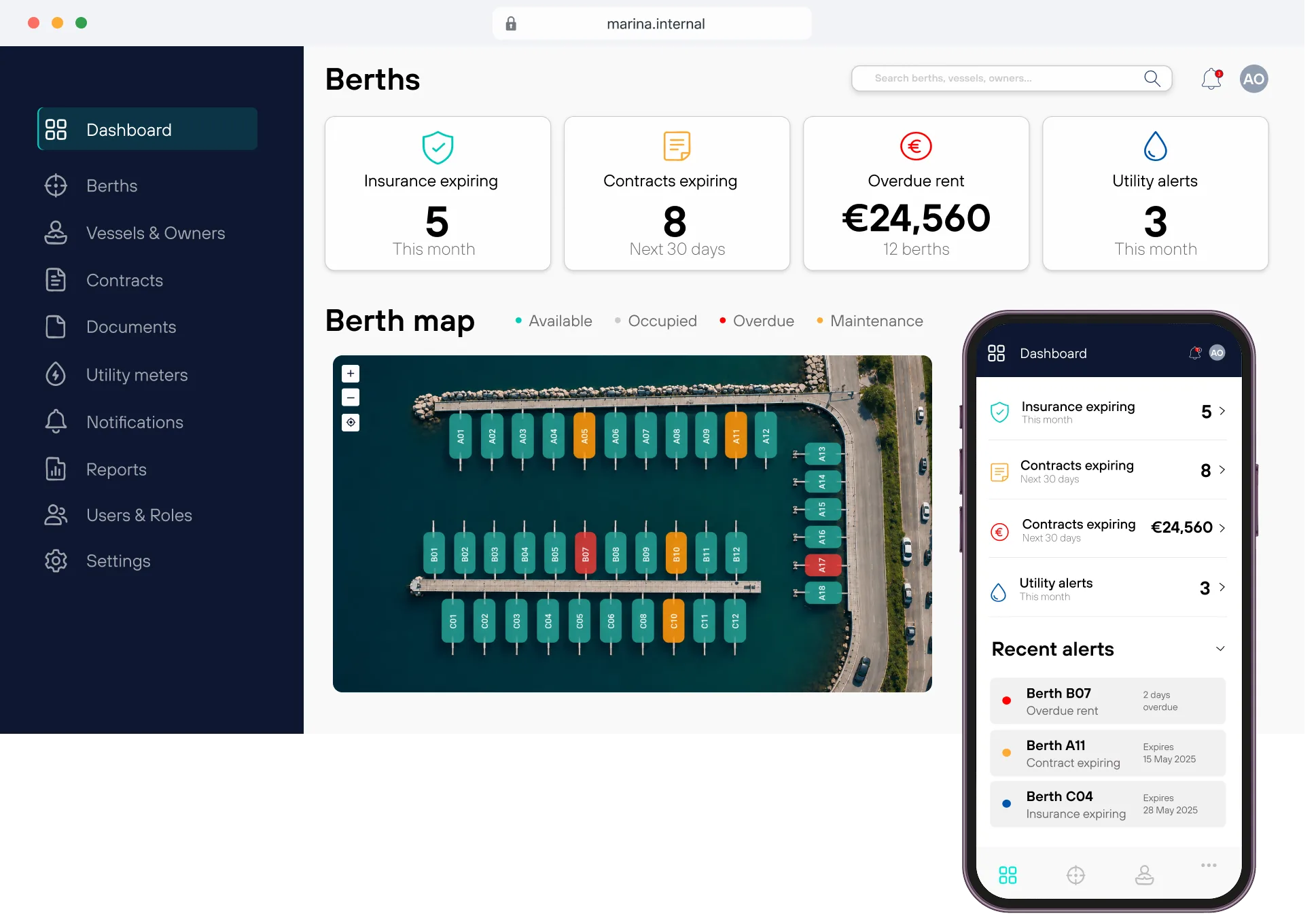
Wetelo built a marina management platform that replaces spreadsheets, paper contracts and printed dock layouts with a single operational picture — an interactive GIS map of every berth, a complete vessel and owner registry, and a contract engine that drafts, activates, alerts and closes annual rental agreements automatically.
A marina operator running a growing harbour on spreadsheets
Our client operates a marina with several hundred berths across multiple piers and zones, serving long-stay annual tenants alongside seasonal traffic. The commercial model is simple — annual rental agreements per berth — but the operational reality had outgrown the tools running it.
Berth occupancy lived in a spreadsheet. Contracts lived in a folder. Vessel certificates and owner ID scans lived across email, a shared drive and paper. Answering a single routine question — who owns the boat on B-10, when does their contract end, and is their insurance still valid? — meant opening three systems and walking to a filing cabinet.
The existing maritime software market didn't solve it either. The large maritime suites are built for fleets at sea: crew rotation, planned maintenance, voyage performance, emissions reporting. A marina doesn't move. Its problem is spatial and contractual, not operational-at-sea — and adapting a fleet ERP to model piers and berths meant paying for thirty modules to use none of them properly.
Revenue lost to operational blind spots
Five recurring problems, each one traceable to the same root cause: no single source of truth linking the physical harbour to the commercial agreements running on it.
Contract expiry blindness
No spatial awareness of occupancy
Scattered vessel and owner documentation
Payment status went untracked
Every query required manual cross-referencing
Three pillars, one screen each
The spatial engine, the vessel and owner registry, and the contract engine — the key deliverables, shown as the operator sees them.
An interactive vector map of the marina with real-time, colour-coded berth status. Clicking any polygon opens a quick-view panel with vessel, owner, contract end date and utility readings.
Harbour schematic — Zone North
- Vacant
- Occupied
- Reserved
- Selected
Pier A
Pier B
Pier C
Pillar 1 — The spatial engine . A vector harbour schematic where every berth is a clickable polygon coloured by status, drilled down Marina → Zone → Pier → Berth. A schematic, not satellite tiles: legible at any zoom, in any light.
From three disconnected sources of truth to one operational picture
Every manual lookup becomes one click. Every silent expiry becomes a scheduled conversation. Projected impact:
of contract expiries surfaced in advance
Automated 60- and 30-day alert windows replace manual calendar checks — no agreement can lapse unnoticed.
faster berth status lookups
The live map answers occupancy, owner and contract-end questions in a single click instead of a three-system cross-reference.
less time spent retrieving documents
Certificates, policies and IDs sit in a structured vault attached to the vessel and owner records.
reduction in idle berth days
Vacancies appear on the map the moment a contract closes, so slips can be resold the same day rather than at the next manual audit.
faster overdue payment follow-up
Automated flags on unpaid annual rent turn collections from an end-of-year exercise into a weekly routine.
less administrative load per contract
Draft → activate → PDF → alert runs as one automated chain instead of five manual steps.
Figures are projected outcomes based on the manual workflows the platform removes.
Audit-ready compliance
Insurance and seaworthiness expiry dates are tracked as first-class data, not as paper.
Proactive revenue recovery
Overdue rent is flagged automatically, not discovered at year-end.
Institutional knowledge captured
The system knows what previously only long-serving staff knew.
Portfolio-ready foundation
The Marina → Area → Pier → Berth hierarchy scales to additional marinas without a data model rewrite.
Mapping a physical harbour into a clean relational model
Marina operations look simple until you model them. A berth is occupied by a vessel that belongs to an owner who holds a contract that may cover several berths — and every one of those relationships changes over time. Discovery mapped the physical, commercial and compliance workflows of a working harbour, then translated them into a hierarchy that mirrors reality.
Physical workflows
- —Marina layout and zoning
- —Pier and wharf structures
- —Berth dimensions and types
- —Utility metering (power, water)
Commercial workflows
- —Annual rental agreements
- —Multi-berth and multi-vessel contracts
- —Pricing and renewal terms
- —Payment schedules and overdue handling
Compliance workflows
- —Owner identity documents
- —Vessel insurance and expiry
- —Seaworthiness certificates
- —Registration papers and photo evidence
From draft to expiry — automated
Drafting
Link Owner → Vessel → Berth. Set dates and pricing. One contract can cover multiple berths or vessels.
Activation & PDF generation
A signed digital PDF is generated and stored against the contract.
Automated alert window
Notifications fire at 60 and 30 days before expiry — to the operator, optionally to the owner.
Renewal or termination
Auto-renewal or manual termination. On end date the berth becomes immediately resellable.
- Basis
- Annual (365 days)
- Multi-asset
- Multiple berths / vessels per agreement
- Output
- Digital PDF contract
- Alert window
- 30 and 60 days prior
- Renewal
- Automatic or manual
Overdue payments are flagged with automated notifications — keeping revenue recovery proactive rather than reactive.
Key Features Delivered in MVP
Every berth mapped, every document dated, every contract on a countdown.
Interactive GIS berth map
Vector schematic with live color-coded status for every slip.
Universal search
Find any berth by vessel name, owner name, phone number, ID number or berth ID, instantly.
GIS precision import
GeoJSON and Shapefile support for accurate layout scaling and berth polygon geometry.
Secure document vault
Encrypted storage for vessel photos, PDF certificates, signed contracts and identity documents.
Smart notifications
Automated alerts for expired insurance, approaching contract expiry and unpaid annual rent.
Photo OCR for identity documents
Auto-extract owner data from government-issued documents on upload.
Multi-berth contracts
One agreement can cover several berths or vessels for the same owner.
Automated PDF contract generation
Signed digital agreements generated on activation and stored against the record.
Utility metering per berth
Power and water readings attached to the berth quick view.
Role-based access control
Admin, Operator and View-only roles keep edit rights where they belong.
Real-time status badges
“Insurance Valid” / “Contract Expiring” visible without opening sub-menus.
Internal-only architecture
No public access, no external vessel-data APIs; sensitive data stays under office control.
A precise, integration-ready web platform
We built a responsive web application rather than a native app — marina office work is desktop-first, but dock walk-arounds need the same map on a tablet.
Looking for a technology partner to turn your spreadsheets and paperwork into one system?
Frequently Asked Questions
What is a marina management system?
A marina management system gives a harbour office one place to manage berths, vessels, owners and rental contracts.
It typically includes a visual map of berth occupancy, an owner and vessel registry, contract lifecycle management, document storage, and automated alerts for expiries and payments.How is this different from ship or fleet management software?
Fleet and ship management suites are built around vessels in motion — crew rotation, maintenance planning, voyage performance, emissions compliance.
A marina is a fixed physical asset, so the core entity is the berth and the contract attached to it, not the voyage. Adapting a fleet suite to a marina means paying for modules you'll never open and working around a data model that was never designed for piers and slips.Why an interactive map instead of a spreadsheet?
A spreadsheet tells you a berth is occupied. It doesn't tell you where that berth is, what's next to it, or which nearby slips are free.
A vector map turns occupancy into an instant visual answer — and makes vacant, revenue-generating capacity impossible to overlook.Can the system import our existing marina layout?
Yes. The platform accepts GeoJSON and Shapefile imports, so an existing surveyed layout comes in with accurate scaling and berth polygon geometry.
Layout changes are handled by the support team to prevent configuration errors.How does contract expiry alerting work?
Notifications fire automatically at 60 and 30 days before an agreement ends, to the operator and optionally the vessel owner.
When a contract closes, the berth reverts to Vacant on the live map immediately, so it can be resold the same day.
Can vessel owners log in themselves?
Not in this design — the system is internal-only, with all data entered and controlled by office staff.
An owner-facing portal for self-service renewals or document uploads can be added as a later phase.Can it integrate with accounting, payment or ERP systems?
Yes. The backend is integration-ready. Contract, invoice and payment data can be synchronised with accounting platforms, payment providers or an existing ERP, so the marina platform doesn't become another data island.
How much does a custom marina management system cost?
It depends on the number of marinas, layout complexity, integrations, contract rules and the level of document automation required.
Most projects start with discovery, where we define the spatial hierarchy, user roles, contract logic, integrations and a realistic MVP scope.