Custom AI Transformation Platform for Workforce Efficiency
Wetelo helped design and develop a SaaS platform that enables companies to measure AI-driven efficiency gains, forecast business impact, and distribute part of that value back to employees through reduced working hours, salary improvements, training investments, and stronger workplace autonomy.
The platform was built around a human-centered approach to AI adoption: instead of treating automation only as a cost-cutting tool, it helps organizations understand how AI affects productivity, workforce value, employee motivation, and long-term business performance.
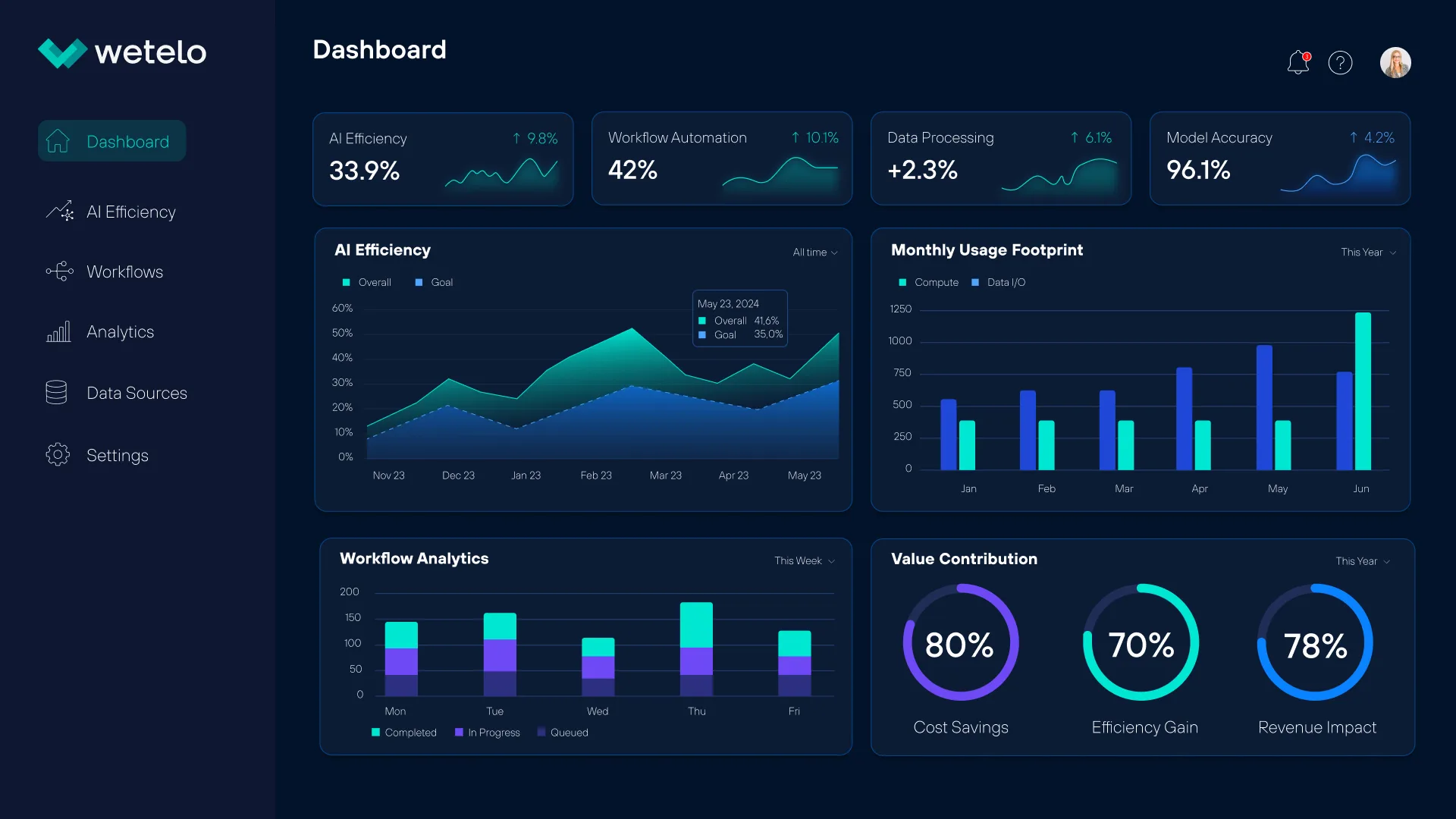
Wetelo developed a custom SaaS platform that transforms complex AI productivity, workforce, and financial data into clear calculations, dashboards, simulations, and actionable recommendations.
The platform helps companies answer critical questions:
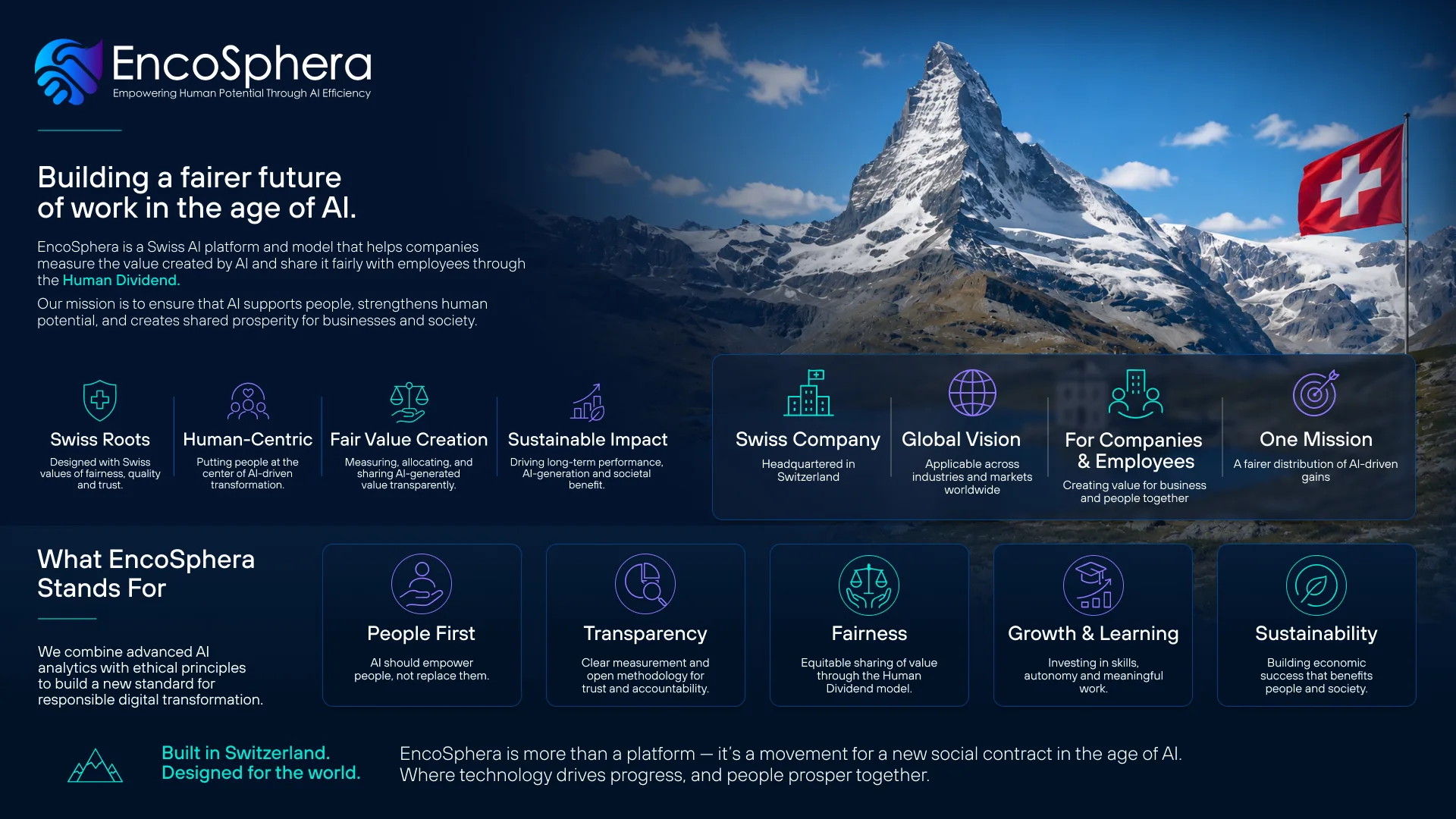
EncoSphera is a Swiss technology company focused on responsible AI transformation and human-centered automation
Wetelo successfully delivered the project, meeting the client's expectations. The team held weekly meetings to provide demos and progress updates. Wetelo's responsiveness, timeliness, transparency, and cost-effectiveness were hallmarks of their work.

Do you recognize these challenges?
AI efficiency gains were difficult to measure
Automation benefits were often viewed only as cost savings
No clear model for fair value distribution
Workforce, finance, and AI data were disconnected
Scenario planning was too complex for non-technical users
Turning a complex AI transformation model into a usable SaaS product
During the discovery phase, Wetelo analyzed the client's business model, mathematical framework, user roles, data structure, and expected platform workflows.
The main challenge was to transform a 30-parameter model into an intuitive product that different stakeholders could use without deep technical or mathematical knowledge.
Model logic analysis
We mapped the full calculation logic behind AI efficiency gains, workforce parameters, financial impact, and value distribution.
User role definition
We defined platform views for different stakeholders, including management, HR, finance, implementation teams, and employees.
Data structure planning
We structured the platform around key input groups:
- Company and employee data
- AI investment and efficiency assumptions
- Financial and operational metrics
- Value distribution rules
- Re-humanisation factors such as autonomy, purpose, and training
Scenario planning logic
We designed how users could adjust parameters and instantly compare different transformation scenarios.
Dashboard and reporting UX
We planned how to visualize complex calculations in a clear, decision-friendly way through dashboards, reports, and interactive charts.
A scalable SaaS platform with calculation, simulation & analytics layers
MVP-first delivery — modeling, dashboards, then enterprise scale
An MVP-first plan that put the heaviest manual workflows first. Frontend and backend ran as parallel tracks, and partners started using each module the moment it shipped.
Platform foundation
Sprint 1Core SaaS foundation
Calculation Engine
Sprint 2Implementation of the core model logic
Scenario planning
Sprint 3Interactive forecasting functionality
Dashboards & Reporting
Sprint 4Business-friendly analytics layer
Integrations & Automation
Sprint 5Scalable data operations
Future Growth
Planned platform expansion
Ten capabilities that make AI transformation measurable
30-parameter AI transformation model
A structured model spanning company, workforce, AI investment, financial, and human-centered parameters.
Business value: Evaluate AI with a measurable, transparent framework instead of assumptions.AI efficiency gain calculator
Calculates how AI adoption improves productivity, reduces costs, and affects performance over time.
Business value: Leadership understands expected ROI and makes better investment decisions.Human value distribution logic
Models how part of AI-generated value is reinvested into reduced hours, salary, or training.
Business value: Build responsible AI strategies and improve employee trust.Scenario planning & what-if simulations
Compare multiple transformation scenarios by changing key parameters and seeing impact instantly.
Business value: Test strategies before making high-impact organizational decisions.Workforce impact dashboards
Visualizes how AI affects working hours, salaries, training, autonomy, purpose, and development.
Business value: HR connects AI transformation with well-being and retention.Financial forecasting & ROI tracking
Calculates cost savings, profit impact, efficiency gains, and return on AI investment.
Business value: Finance gets clear visibility into the economics of transformation.Role-based dashboards
Each stakeholder sees the data and insights relevant to their responsibilities.
Business value: One shared model, the right level of detail for every team.Data import & validation
Structured input, Excel imports, validation rules, and consistency checks.
Business value: Start without complex integrations, keep data quality in control.Recommendations & action planning
Identifies recommended actions based on model outputs, scenario results, and goals.
Business value: Not just calculations — practical direction for implementation.Auditability & transparency
Every parameter, calculation step, and scenario can be traced and reviewed.
Business value: Trust in the model, support for governance and compliance.
Try the what-if engine at the core of the platform
A simplified model of the simulation module. Adjust AI investment, expected efficiency, and how much value flows back to people — and watch the business and workforce outcomes update live.
Illustrative model · baseline of 200 employees. The production engine runs 30 parameters with validation and audit trails.
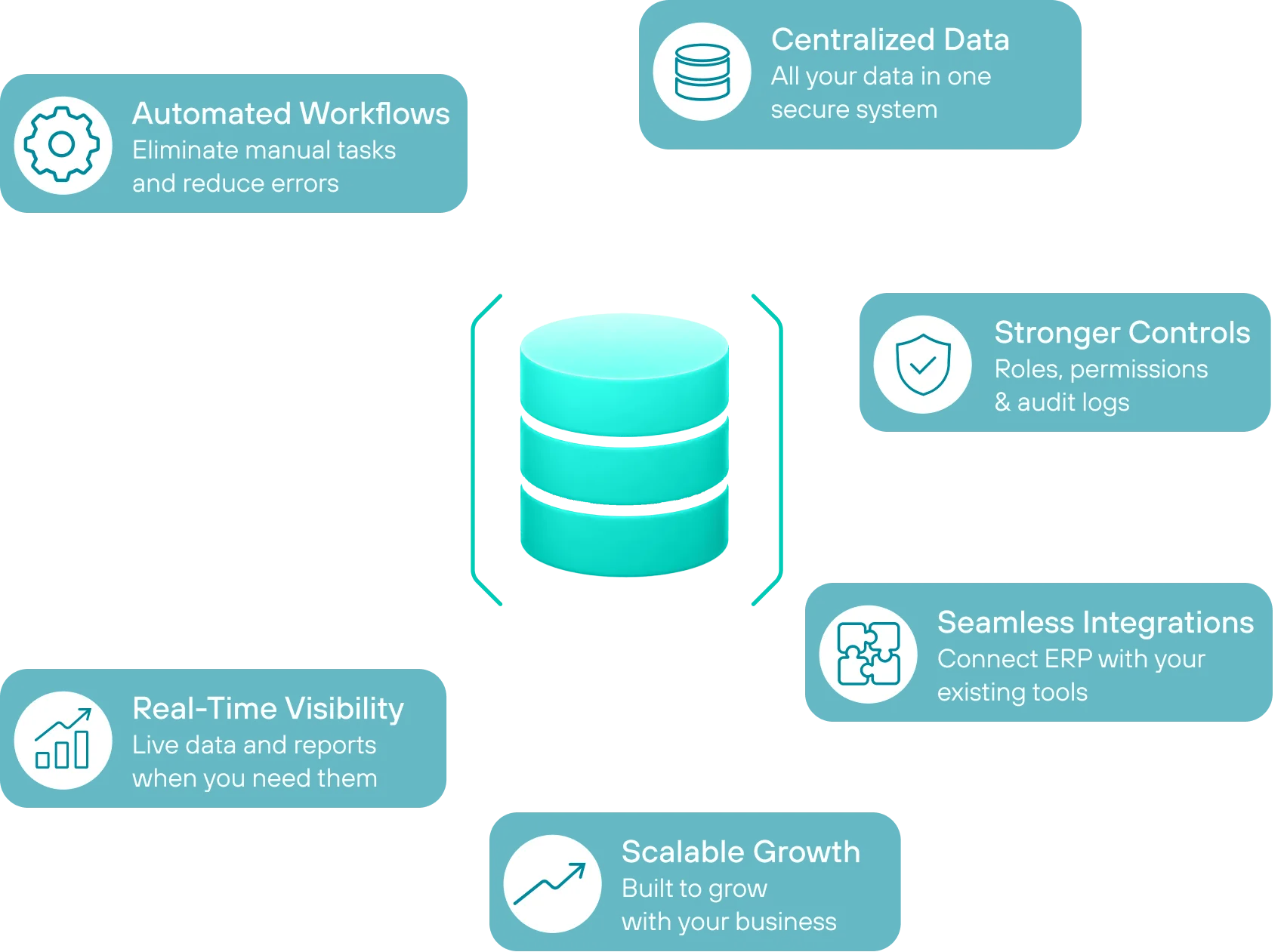
A secure and scalable SaaS architecture for enterprise AI transformation
The platform was designed as a browser-based SaaS solution that does not require local installation and can scale with company size, data volume, and user roles.
From AI uncertainty to measurable transformation planning
The platform helps companies move from abstract AI discussions to measurable, data-driven transformation planning.
Clearer AI ROI visibility
Companies can calculate and compare the expected business impact of AI initiatives before and during implementation.
Faster strategic decision-making
Scenario planning helps leadership teams compare transformation options without manual spreadsheets or complex offline calculations.
Stronger employee trust
By showing how AI-generated value can also benefit employees, companies can reduce resistance and make AI adoption more transparent.
Better workforce planning
HR teams can understand how automation affects working hours, training needs, salaries, and employee development.
Improved governance
Transparent calculations, audit trails, and role-based access help companies manage AI transformation responsibly.
Scalable AI transformation process
The platform creates a repeatable framework for companies to measure, plan, communicate, and optimize AI adoption over time.
A custom SaaS platform that turns AI transformation into a measurable, transparent, and human-centered business process — helping companies balance productivity, profitability, and employee value.
Frequently Asked Questions
What is an AI transformation platform?
An AI transformation platform helps companies plan, measure, and manage the impact of AI adoption across business operations, finance, and workforce processes.
It can include data modeling, efficiency calculations, scenario planning, dashboards, reporting, and recommendations for implementation.What is AI efficiency modeling?
AI efficiency modeling is the process of calculating how artificial intelligence can improve productivity, reduce costs, automate tasks, or optimize operations.
In a custom platform, this logic can be translated into interactive calculations, dashboards, and forecasts that help companies make better decisions.What data is needed for an AI transformation platform?
The required data depends on the business model, but it may include workforce data, salary structures, working hours, financial metrics, AI investment plans, operational costs, efficiency assumptions, and training or employee development factors.
Can an AI transformation platform integrate with existing company systems?
Yes. A custom platform can be integrated with ERP, HR, finance, payroll, analytics, and internal business systems.
It can also support manual data entry or Excel imports for companies that are not ready for full automation at the first stage.How does the platform support human-centered AI adoption?
The platform helps companies connect AI efficiency gains with workforce outcomes such as reduced working hours, salary improvements, training budgets, autonomy, and employee development.
This makes AI transformation more transparent and easier to communicate across the organization.
How do you ensure data security in AI and workforce analytics platforms?
Security should be built into the architecture from the start.
Typical measures include role-based access control, encrypted data transfer, secure authentication, audit logs, controlled permissions, environment separation, and strict handling of sensitive workforce and financial data.How much does custom AI transformation platform development cost?
The cost depends on the complexity of the model, number of user roles, dashboards, integrations, data sources, security requirements, and reporting functionality.
A simple MVP may include core calculations, manual data input, dashboards, and basic reports. A more advanced platform may include automated integrations, scenario simulations, AI-powered recommendations, enterprise governance, and employee-facing dashboards.
Most projects start with discovery, where we define the model logic, user flows, technical architecture, integration scope, and realistic development roadmap.